
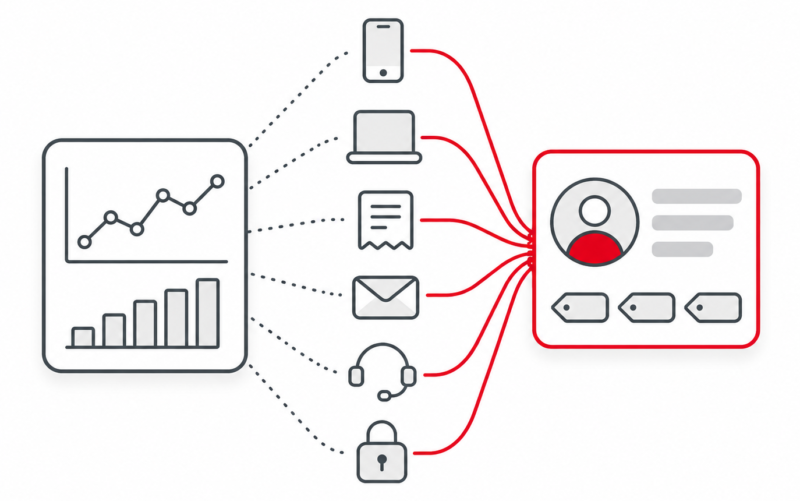
Data is the most valuable asset for any business, because it will steer your business for the major business decision. A Customer Data Platform could help you answer questions such as which products or features you should develop, which marketing campaigns you should run, and where the friction points are in your customer journey. If your business has multiple customer touchpoints, your customer or sales data are likely scattered across different places. In that case, investing in customer data platforms becomes far more important.
Understanding Customer Data Platforms and Their Use Cases
What is a Customer Data Platform and what are the differences?
A Customer Data Platform (CDP) is a software system that collects data from various data streams across different software and tools and stores it for further analysis. There are multiple CDPs from major companies, and each of them has its own pros and cons based on your business needs.
According to CDP Institute, there are 4 types of customer data platforms:
- Data CDPs: Data CDPs gather customer data from various systems, store it safely in a database, and provide the data to external systems for detailed analysis.
- Analytics CDPs: Analytics CDPs not only collect data but also provide analysis through data segmentation and modeling. The analytics features will be different based on the provider.
- Campaign CDPs: Campaign CDPs help solve marketing pain points by not only unifying and segmenting customers but also helping teams orchestrate and deliver hyper-personalized marketing messages and experiences to individual customers across multiple channels.
- Delivery CDPs: Delivery CDPs provide delivery automation across multiple touchpoints to send emails, SMS, and push notifications.

Nowadays, there are all-in-one customer data platforms such as Tealium and Twilio Segment. However, some CDP systems may be better at analysis, and some may be strong at the delivery and distribution. In that case, consulting CDPs solutions providers like Inetasia will save your time and cost rather than trying to guess which suits your organization the best.
Key Features and Core Capabilities of Customer Data Platforms
Most customer data platforms have these common features below, though the way they present the data, and integration will be dependent on the specific system.
- Data Ingestion. CDPs capture data from various sources, such as websites, mobile apps, CRM, point of sale, email, and more.
- Store data Safely. Retention follows your privacy rules, not a vendor’s storage limit.
- Customer Data Unification & Segmentation: CDPs connect customer data across devices, and channel build the 360° customer profile, and then Segment the customer groups based on the behavior and traits.
- Connect Data Across Systems: Send customer audiences and profile data to the tools your teams use to engage with customers.

The Limitations of GA4 and Why is not the Best Choice For Customer Data Analysis
GA4 is good at its specific use cases, and defined scope. When it comes to customer profiling, segmentation, and creating personalized campaigns, GA4 alone will not help you out. Here is why:
Lack of Unified Customer Insights Across Multiple Data Sources
You will not get your true customer profile with GA4. Period. GA4 struggles to sync the anonymous users to their known profiles after the user has logged in and becomes known users. The result is that you will see the bloated users, which lead to misinterpretation, and wrong business decisions. Most importantly, GA4 now works on mobile, and websites, but almost every business has multiple customer touchpoints such as social media, email, and so on. So, in order to define who your real customers are, GA4 has significant limitations.
Insufficient Customer Journey Mapping on Different Touchpoints
GA4 captures the top-of-the-funnel activities, and answers where your customers are coming, and not what they do, and why they do it. If you see the friction points in customer journey, or inefficiency in conversion steps, GA4lacks the native tools for further analysis, and defines the solutions, such as session replays, heatmaps, and deep product behavioral analytics .
Challenges in Integrating Customer Data Across Multiple Platforms
After you have collected the data, you need to send that data to specific teams or departments for further analysis, as each team uses their own specialized tools. GA4 is designed to do the lightweight analysis in its own interface. The raw data is trapped in GA4, unless you export it to Google BigQuery, and implement the technical integration.
Ineffective Sales Enablement and Customer Data Access
GA4 normally anonymizes the data, so sales teams could not rely on its data to define who is the real potential customer. Moreover, GA4 has no native integration to push real-time user timelines into standard sales software like Salesforce or HubSpot.
Insufficient Analytics for E-commerce Customer Behavior and Performance
In the world of ecommerce, data accuracy is the most important thing. If you are used to analyzing the conversion data with GA4 for your ecommerce website, you will see discrepancies between the real conversions, and conversion that GA4 reports. This is because the GA4 relies on the user’s client-side browser as it could normally be blocked by ads blocker, and tools. Moreover, GA4 separates the users if the user clears their cookies or logs in with a different authenticated browser.
Lack of Real-Time Customer Data Activation and Personalization
Time is money for most businesses. If the customer could not find what they want within the targeted time, they will switch to another business or services. GA4 does not have real-time data activation capabilities. Furthermore, GA4 also has server latency and delayed times, so engaging the customer during their customer journey would be impossible with GA4.

Three Common Customer Data Problems That CDPs Can Help Solve
Investing in CDPs has several business benefits. But, here is our top 3 picks:
1. Unifying Customer Data Integration Across Multiple Sources
With CDPs, you could utilize your campaign budgets to the channel that brings the customer most. It could also send the conversion data back to the ads platforms like Google, or Meta, so that the platforms could show your ads to the most likely customers who match with your real conversion data.
2. More Efficient Customer Journey Mapping Across Every Touchpoint
Instead of blindly sending the messages to all of your customers, you could personalize their experiences with targeted messages. With CDP integrations, you could create real-time “In-session” behavioral campaigns, for example you could encourage your customers who added-to-cart to purchase with tailored messages or the promotion.
3. Creating Complete and Unified Customer Profiles
Ability to integrate the data with different tools, and software is the best advantage of using customer data platforms.

How We Used CDP Platforms to solve Our Client’s Success
Haka House is the Hotel brand in New Zealand that allows the booking on their website. They wanted to spend their budget efficiently by targeting customers who were most likely to book a room on their platform.The first thing we did is define their needs to help them choose the CDP platforms with consulting calls.
Unifying Customer Data Across Multiple Platforms and Sources
They have multiple channels for the customer touchpoints. Inetasia solutions chose Amplitude for their needs and helped implement user activity overview to their platform. They get the monthly reports that show the real(not bloated) users data, and their activity for their campaign.
Building a Complete View of the Customer Journey Across Channels
With the help of CDP, we created the complete customer journey and conversion funnels, so that the respective teams could analyze where and why the customer dropped off before making a successful conversion.With the ongoing optimizing of the conversion funnels, Haka House sees a positive improvement across quarterly benchmarks.

Connecting Customer Data to Improve Segmentation and Personalization
With the full customer profile in place, we created better customer segmentation based on behavior and purchase history.
In this way, Haka House created the personalized ads, targeting the right segmented customer, which resulted in higher conversion rates.
Finding the Right Customer Data Platform for Your Business
As we discussed, getting help from an agency that provides multiple solutions can save you time and money when choosing the right CDP for your business.
In order to find the right customer data platform, firstly you need to define the problems you want that CDP might help solve.Then, define the budget, and compare the CDPs that directly solves your problems. Some CDPs overqualified as well as over-budget. So, targeting the right fit is the right way.
Overall, GA4 serves its core purpose of analyzing website and mobile app performance, but if a business has multiple customer touchpoints and needs a complete view of its customers, a CDP can provide a more complete solution.
